Ten minutes of setup, then it starts finding federal work you can actually bid on
Your UEI is the first field, not the whole setup. It pulls your public registration record, you add what you do and what you have won, and the assistant matches live solicitations to your NAICS codes and set-asides. You do not need to know the vocabulary yet.
Free plan never expires. One full proposal included, no card, no sales call.
Three things, about ten minutes, then the feed starts filling
The UEI is step one of three. The other two are what make the matching worth reading.
Paste your UEI
It reads your public registration record and builds the company profile from it: entity details, NAICS codes, set-asides, place of performance. You do not retype anything that already exists on the record.
Tell it what you do and what you have done
Capability statement, past performance, certifications, rates, key staff. Drop in what you already have and it sorts it into your library. That library is what every later draft is written from.
Set what you want to see
Agencies, contract sizes, NAICS codes, set-asides, keywords you care about and ones you never want again. Change any of it later in a click.
A live solicitation feed that also tells you which ones are already decided
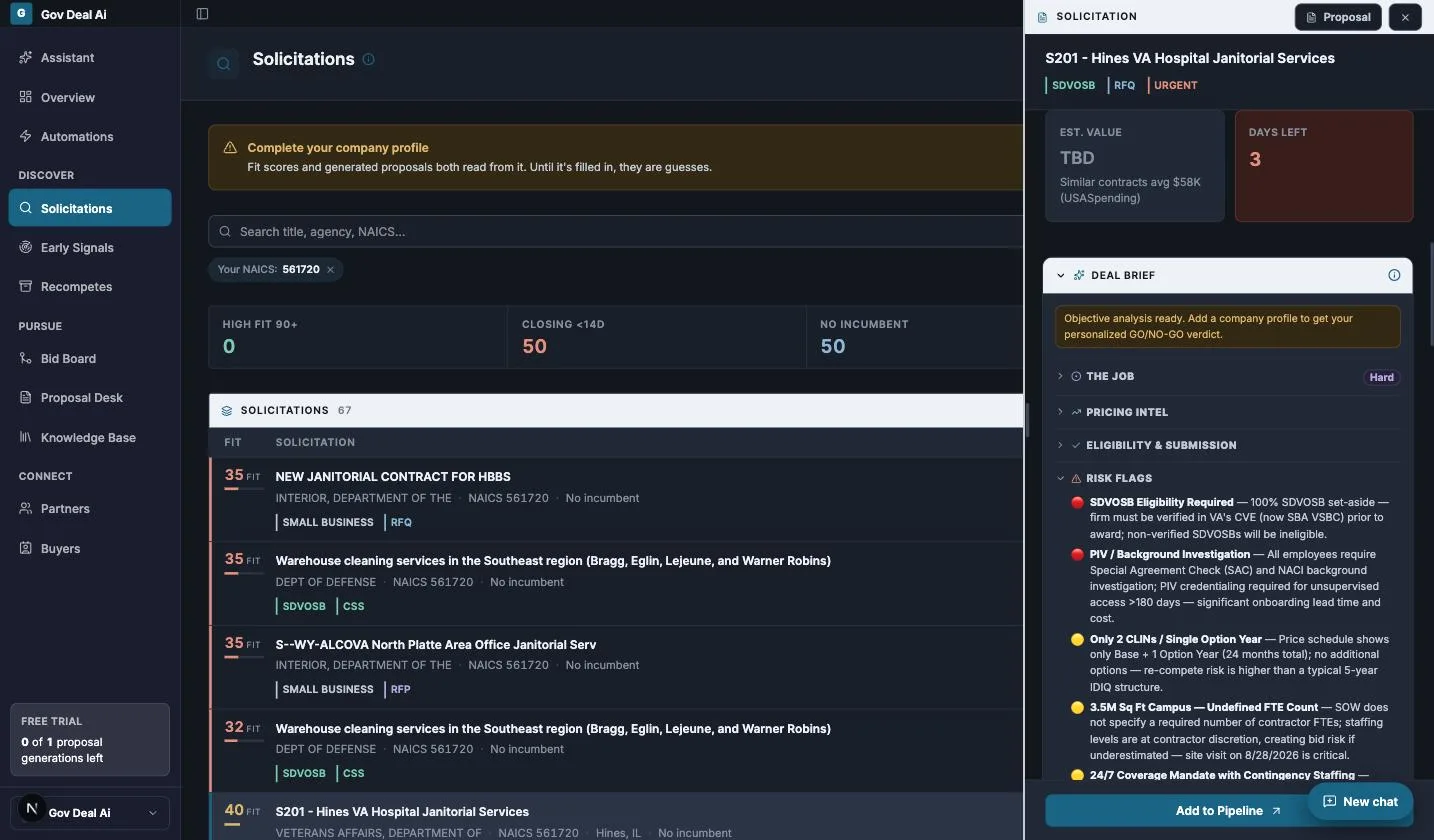
Filtered to your NAICS codes and your set-asides: SDVOSB, 8(a), WOSB, HUBZone, small business.
A fit score on every notice
Each notice is scored against your profile. The feed is ranked by what you can realistically bid, not by what posted most recently.
A Deal Brief with a verdict
GO, CAUTION or NO-GO, with a PWIN number and the factors behind it. You see the reasoning, not just the score.
Incumbent and award history
Who won it last time, how many offers came in, and what they were paid, read from FPDS. SAM.gov does not show award history, so this is where a solicitation wired for the incumbent shows itself.
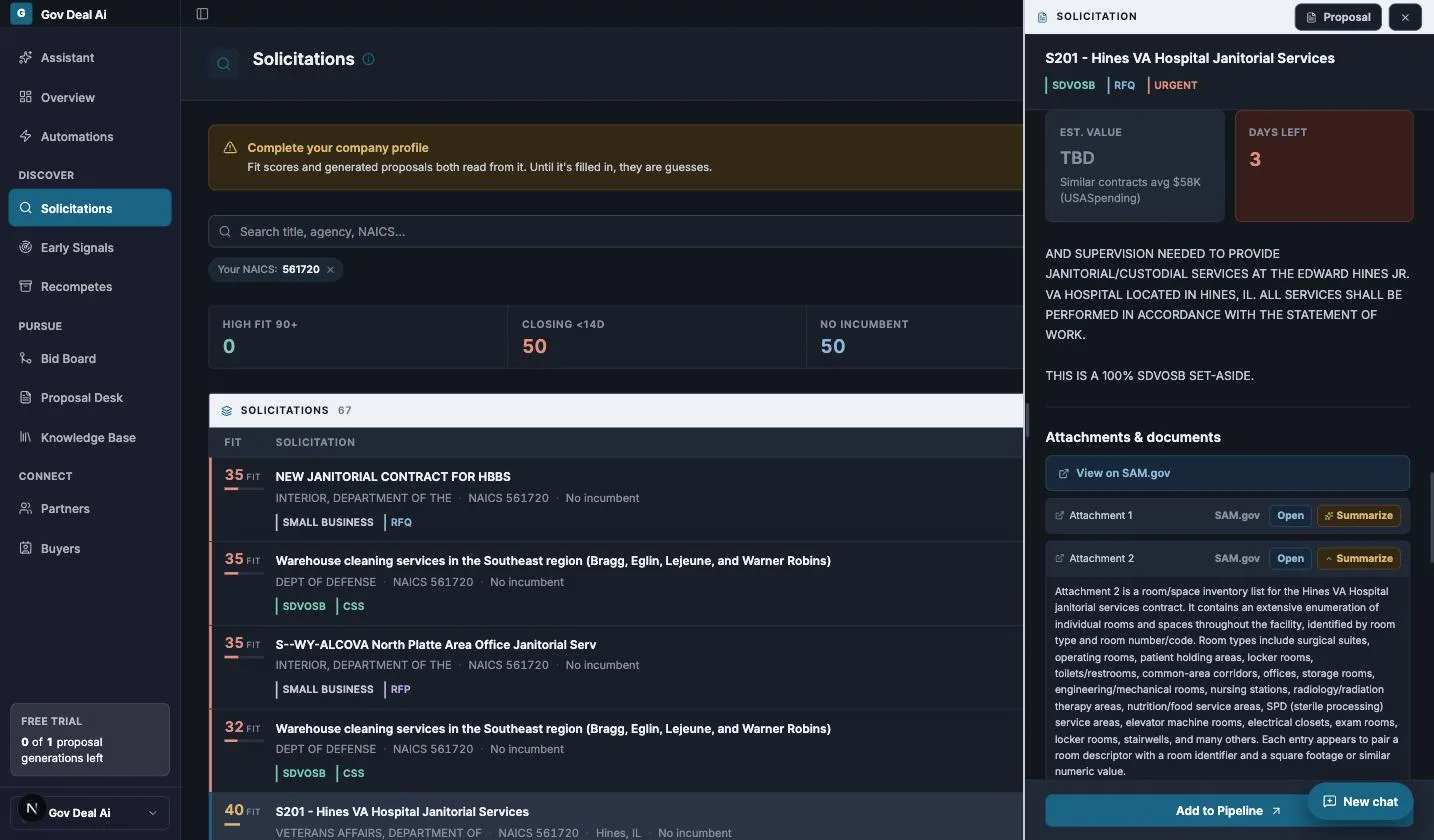
It reads the attachments, not just the notice
The requirement is never in the notice paragraph. It is in the package behind it.
Per-attachment summaries
The PWS, the wage determination, Section L and Section M, each summarised on its own terms rather than blended into one paragraph.
Every amendment read
Amendments are read with the rest of the package. A change buried in the eleventh one does not slip past you.
A compliance matrix
Requirements come out line by line into a matrix you can work against. That is the thing you actually write the proposal from.
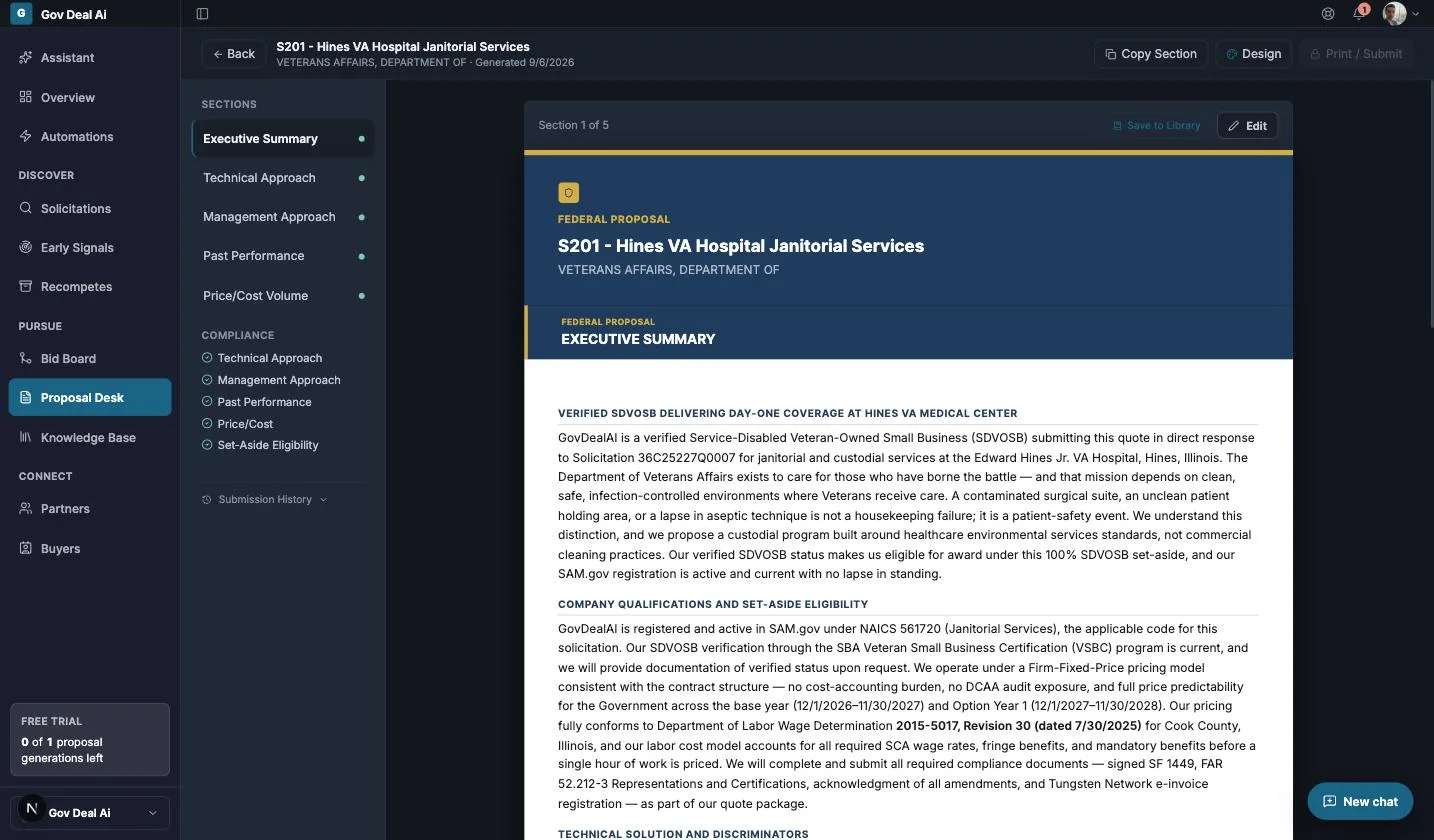
It drafts section by section from your own approved library
Past performance, CPARS narratives, rates and certifications, written against the compliance matrix for this specific solicitation.
Your words, not a template
Drafts are built from your approved library and the matrix, so the content traces back to work you have actually done.
Pink, red and gold team reviews
Each review scores the draft and hands back one-click rewrites. Nothing reads ready until it has been through all three.
Export when it is finished
Word, PDF and more, on the paid plan.
Every step is yours to do by hand. The co-pilot just gets there first.
The whole workflow is in the app as a set of tools you can drive yourself. The AI agent is the fast path through it, not the only path.
Drive it manually
Search the feed yourself, open the package yourself, write the sections yourself. Nothing is locked behind the agent and nothing is hidden from you.
Or hand it to the co-pilot
It scores the feed, reads the attachments, builds the matrix and drafts the sections, then puts the result in front of you to approve.
You keep the final say
Edit any line, override any score, rewrite any section. Nothing reaches an agency without a fresh click from a human.
Most of what decides a bid happens months before the solicitation posts
The early work is finding the requirement while it is still being shaped, and being known before the package drops.
Early signals feed
Agency forecasts, sources sought notices and presolicitations matched to your NAICS codes, so you see a requirement before it becomes an RFP.
Capability statement responses
AI-drafted responses to sources sought, plus a recompete watch on the contracts you want the next crack at.
Teaming partner search
Search the SBA DSBS directory for a partner who holds the set-aside you do not have yet.
A wrapper has nowhere to send from, so it has nothing to check
These are the parts that only exist because submissions leave from here.
Six checks before the send button
The package goes through six pre-submit checks, and the button stays inactive until all six have cleared.
Section L verification
It verifies the contracting officer email against Section L, which is how it catches a notice listing a contract specialist instead of the CO.
Delivery tracking and a hard stop
Sent, delivered or bounced, on the record. Every submission needs a fresh human click, and every action is logged.
Free to keep. $350 a month when you want to send.
Published on the page, so there is no call to find out. For comparison: AI proposal platforms run about $20,000 a year. GovWin, Deltek and Bloomberg Government start at $25,000 a year after a sales call. A proposal consultant is $3,000 to $10,000 per bid.
Free
Not a countdown. The account stays open, and one proposal generation is included so you can take a real bid all the way through before you decide.
- Live solicitation feed filtered to your NAICS and set-asides
- Deal Briefs with PWIN, verdict and award history
- Full attachment reading and a compliance matrix
- One full proposal generation, start to finish
- Early signals, recompete watch and DSBS teaming search
- No card, no sales call
Paid
Unlimited drafting and 10 proposal submissions a month. The meter only counts what you send.
- Everything in the free plan
- Unlimited proposal drafting and pink, red and gold team reviews
- 10 submissions a month, sent from the app with the pre-submit checks
- Export to Word, PDF and more
- 24/7 email and chat support with a human, on top of the AI agent in the app
- No contract and no sales call. Cancel in the app.
Your library stays yours, and it never logs in anywhere as you
Encrypted and scoped to you
Encrypted in transit and at rest, scoped to your account, with per-user permissions and a full audit trail.
Not sold, not training data
Never sold or shared with advertisers. Your content is not used to train models. Export or delete it on request.
Public sources only
It works from public records. It never logs in anywhere on your behalf.
The limits, before you sign up rather than in your second week
Does the free plan expire?
No. It is free forever. What is limited is output: one proposal generation, so you can test the whole thing on a real bid. Submitting and exporting are paid.
How long does setup take?
About ten minutes. The UEI fills in your registration record, then you add your capabilities, past performance and rates, and set your filters.
Do I have to get on a call to pay?
No. $350 a month, card in the app, cancel in the app, no contract. Once you are paying you get 24/7 email and chat support as well as the AI agent inside the app.
It never submits without me?
Correct. Nothing goes to an agency without a fresh human click, and no setting bypasses it.
Does it write my technical approach?
It drafts. You own the technical approach and the judgment behind it.
Does it see every opportunity?
No. Solicitations under $250k that agencies are not required to post will not be there.
Is it SOC 2, FedRAMP or CMMC?
None of those today. Do not put CUI in it.
Is it affiliated with SAM.gov?
No. Not affiliated with SAM.gov, GSA or any agency. SAM.gov registration is always free.